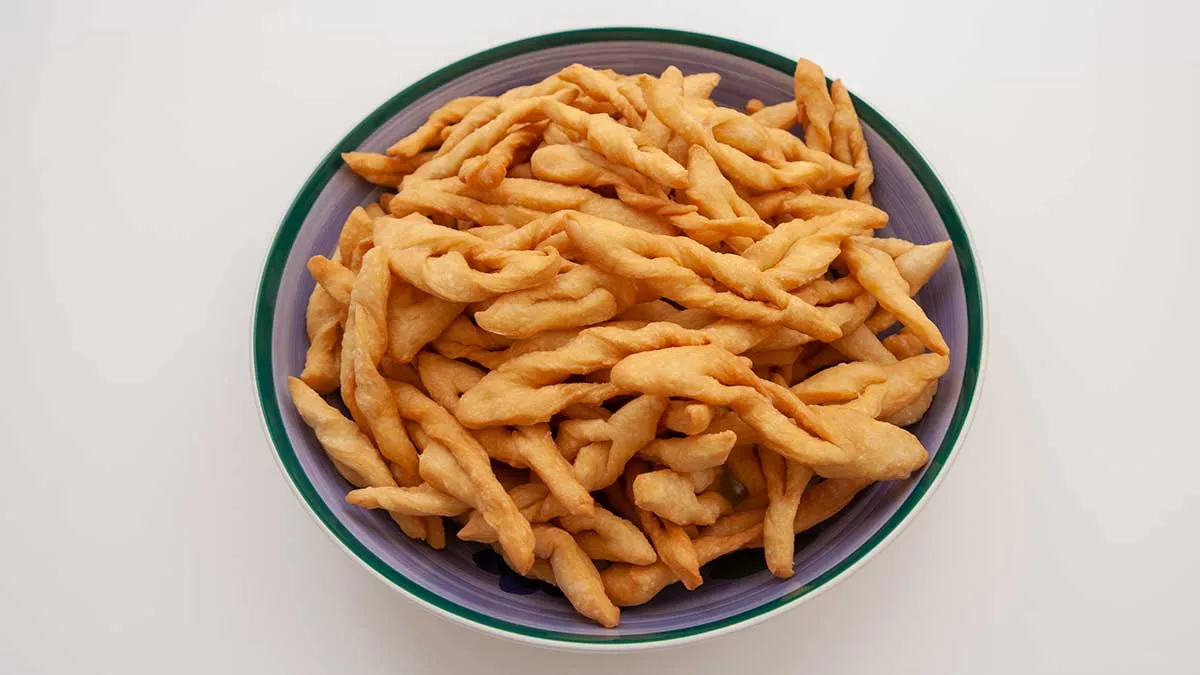
Saucepan@saucepan · Shared this recipeFollowTibetan · snackKhapse Recipe: How to Make Tibetan Losar PastriesA simple Tibetan deep-fried pastry, shaped with a twist, often made for Losar celebrations.servings4Original recipe on yowangdu.comKeep this recipeAdd a copy of Khapse Recipe: How to Make Tibetan Losar Pastries to your Saucepan library.Save to my libraryView in my librarySave it to your librarySign in to keep a copy you can scale, cook from and add to your grocery list.Sign in to saveGet the appSaucepan keeps all your recipes in one place, builds your grocery list and rings timers while you cook. Your account works on the website too.Android is coming soon.PrintCopy ingredients Print photoAndroid is coming soon.Ingredients4 servingsBack to 4 servings4 cups all-purpose flour0.5 cup sunflower oil, or any cooking oil. For softer khapse, use a little more oil.0.333 cup sugar, more sugar if you like sweeter pastries. We used turbinado raw cane sugar. Or, you can make sugar-free khapse by leaving the sugar out.1 cup milk, or 1/2 and 1/2, Dairy product that is half milk and half cream.1 quart sunflower oil for deep fryingStepsClear checksTap an ingredient or step to check it off.1Step 1: Dissolve the sugar in 1 cup of warm water.2Step 2: Combine flour, oil, sugar and 1/2 and 1/2.3Step 3: Mix everything together to make a smooth-ish ball of dough.4Step 4: Knead the dough for several minutes.5Step 5: Roll out the dough to about a 1/4 inch thickness. (When you roll it out you can put a little flour down on the rolling surface so that it won't stick, but not much. If you put too much extra flour, it will make the dough suck up too much oil while cooking.)6Step 6: Cut the dough in strips (maybe about an inch or a little less), then cut those strips into diagonal pieces. Try to make the pieces roughly the same size, so that they can cook at the same rate. This doesn't have to be precise, Tibetans rarely are!7Step 7: Slice a slot in the middle of each piece of dough.8Step 8: Pull one corner of the piece of dough through the slot in the middle, creating a twist. (See the video.) Pull the two ends of your nyapsha a little to even out the shape a bit.9Step 9: We do this outside on a camping stove, as the process is quite greasy and messy.10Step 10: Pour 1 quart of sunflower oil into a large, deep pot or pan.11Step 11: Heat the oil on high until it starts to smoke a tiny bit. The oil will be hot enough when you can drop one piece of dough into the oil and it pops up to the surface right away.12Step 12: Cook the bigger ones first and the smaller ones last. (We made a few larger non-nyapsha shapes too.)13Step 13: Carefully lower the khapse dough pieces into the oil. You will need to make multiple batches, and it is better if you don't fill the pot or pan too full of dough pieces. Fewer khapses in one batch is better.14Step 14: Cook the khapse on high heat until golden brown, moving them around fairly often, and very gently, with a long-handled utensil. They cook pretty fast, in just a few minutes.15Step 15: Remove the khapse from the oil with a slotted spoon or large straining utensil, letting the oil drain over the pan. (The oil can easily splash on you at this point, so please take care.) We place the cooked khapse on paper towels to absorb as much as possible of the oil.16Step 16: You can sprinkle some powdered sugar if you like, but usually we eat these just as they are, with sweet tea or Tibetan tea.17Step 17: Store the extra khapse in an air-tight container and you can keep them quite a while, though they do of course get hard over time.getsaucepan.com/r/7c04aea9-7076-42af-9a89-b7277e1e3be0 · Original: https://www.yowangdu.com/tibetan-food/khapse