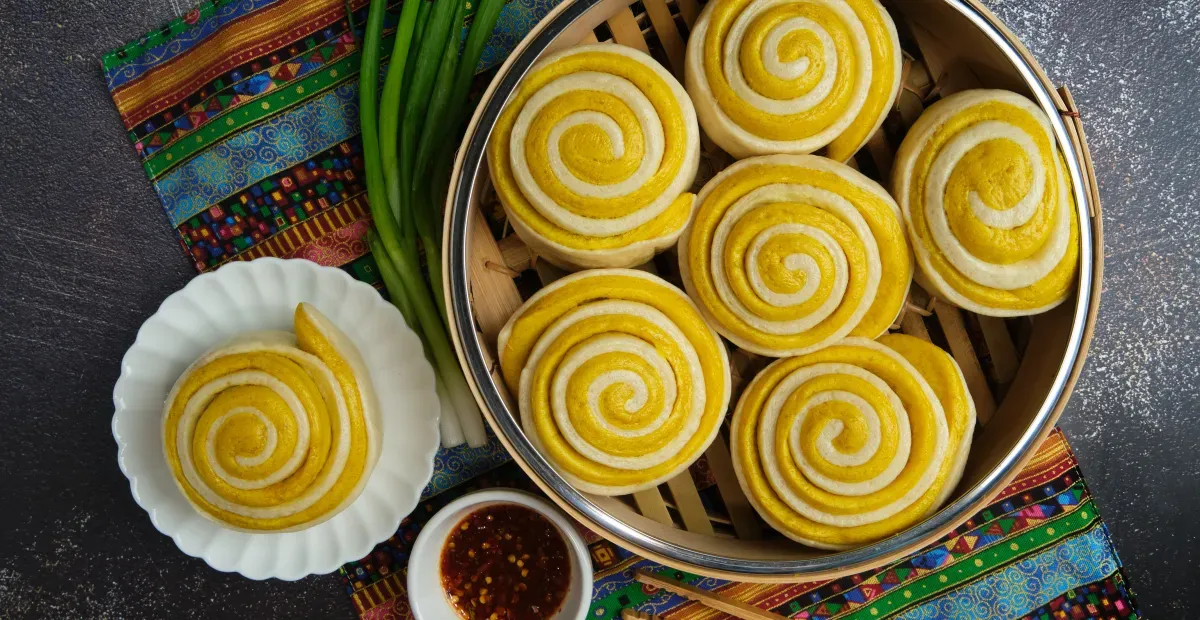
Back to 8 servings For the white dough 2 cups all-purpose flour, 280 grams 1 teaspoon salt 1 teaspoon active dry yeast 0.667 cup water, plus 2 tablespoons, divided 2 teaspoons sugar For the yellow dough 2 cups all-purpose flour, 280 grams 1 teaspoon salt 1 teaspoon turmeric 1 teaspoon active dry yeast 0.667 cup water, plus 2 tablespoons, divided 2 teaspoons sugar Vegetable or any other neutral oil, for brushing
Steps Clear checks Tap an ingredient or step to check it off.
1 Step 1: In two separate bowls, sift together the flour and salt. In one bowl, add the turmeric and mix well. Set both bowls aside.2 Step 2: In two separate bowls, proof the yeast by combining 2/3 cup warm water (105 to 115 degrees, or warm to the touch), sugar, and yeast. Stir gently to dissolve the yeast, then set aside to sit undisturbed for 10 minutes. When the yeast has finished activating, you'll see frothy bubbles.3 Step 3: Mix the white dough first. Put the dry ingredients in the bowl of a stand mixer fitted with a paddle attachment. (You can also mix the dough by hand.) Add the activated yeast mixture on a low speed until the dough comes together. Add 2 tablespoons water to further hydrate the dough if it seems too dry. Switch to a dough hook and knead for about 8 to 10 minutes to develop the gluten. If kneading by hand, knead on a lightly floured countertop for about 12 to 15 minutes. Repeat the same steps to make the yellow dough.4 Step 4: Lightly oil two separate bowls and place the doughs inside them. Cover with plastic or a damp towel, then place in a warm area of your kitchen, such as an oven that is turned off. Note that 77 degrees is the ideal temperature for proofing.5 Step 5: Proof the dough for about 1 to 2 hours or until it has doubled in size. (Proofing times can vary greatly; if you live in a warm climate, the proofing may be done in as little as 45 minutes.) You can check to see if the dough is ready by poking it with your finger — the indentation should remain but the dough will still spring back a little.6 Step 6: Starting with the white dough, dust your work surface with flour and transfer the dough to it. Flatten the dough into a rectangle with your palms. Then, using a rolling pin, roll the dough as thin as you can into roughly a 15-by-17-inch sheet, maintaining its rectangular shape as much as possible. Set aside; repeat with the yellow dough.7 Step 7: Lightly oil the surface of the white dough. Then place the sheet of yellow dough on top and lightly oil its surface as well. Use a rolling pin to lightly press the sheets together. Starting from the short end, roll the dough into a tight log, jelly roll style. Trim both edges and cut the dough into eight equal parts. For smaller tingmomo, you can cut the dough into 10 parts.8 Step 8: Add water to a steamer pot (or any large pot suitable to accommodate a steamer). It should be at least a couple inches deep but not touch the floor of the steamer basket or rack. Bring the water to a boil.9 Step 9: Lightly grease your steamer basket with vegetable oil. Place the tingmomo in the basket, leaving at least 1 to 2 inches of space between each bun to allow for expansion. Cover and steam for about 10 to 12 minutes.10 Step 10: Remove the cooked buns from the steamer. Enjoy them hot. You can dip them in hot sauce or chili oil, or use them to sop up stir-fry dishes. Got leftovers the next day? Slice the tingmo in half and lightly pan-fry them, and then enjoy them with jam.getsaucepan.com/r/9fa8adcc-9929-4aae-8d38-5e36ac838358 · Original: https://www.eater.com/22444632/tingmomo-recipe-tibetan-steamed-buns